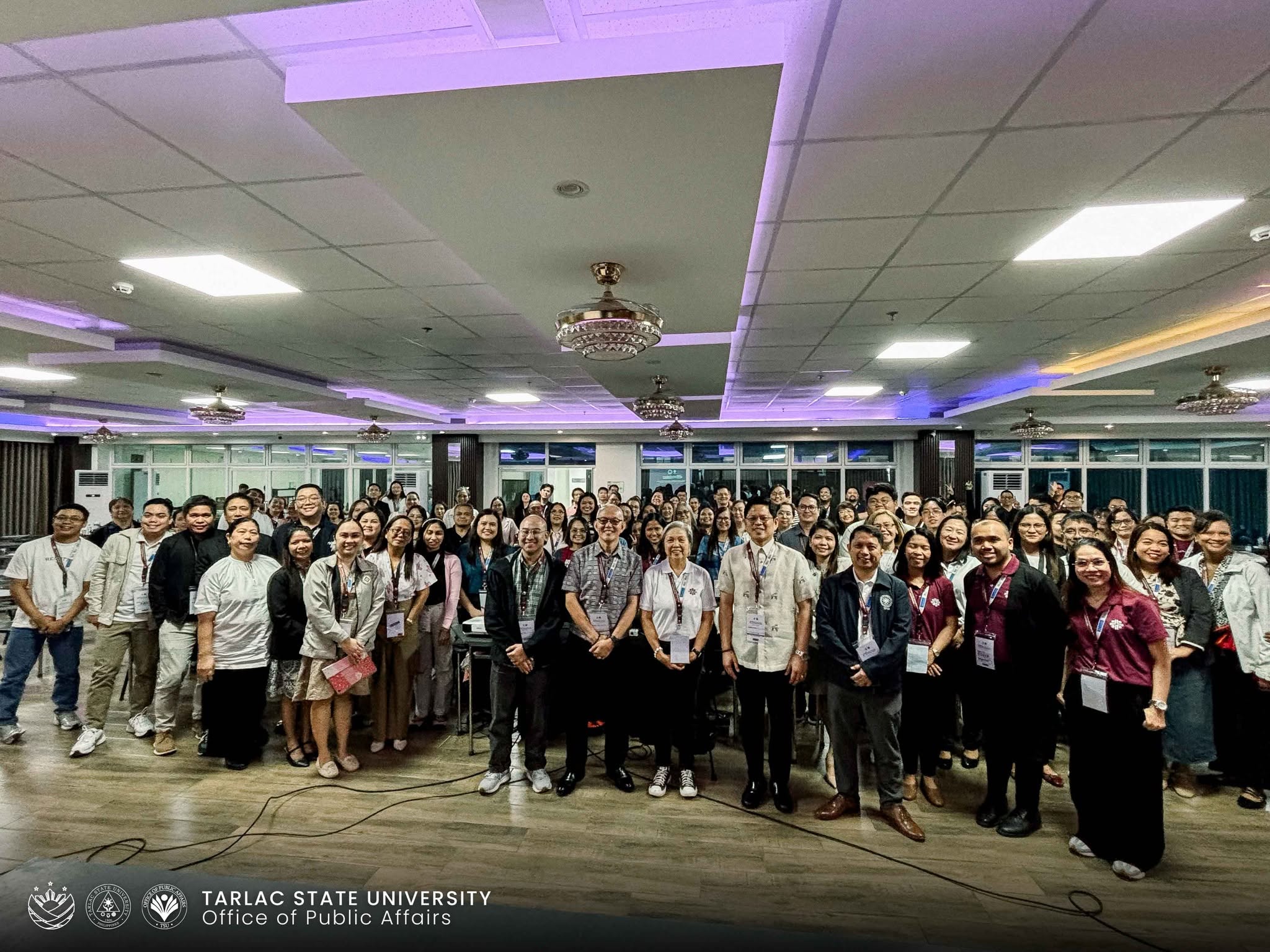
Tarlac State University President Dr. Jasper Jay N. Mendoza served as a plenary speaker at the National Conference on Curriculum Studies (NCCS) 2026, delivering a plenary talk titled “Multigrade Education and Alternative Learning Delivery in Changing Times” on September 27, 2026, at Systems Plus College Foundation (SPCF), Angeles City.
Organized by the Curriculum Studies Association of the Philippines, Inc. (CSAPI), the three-day hybrid conference held on September 25–27 gathered educators, school leaders, researchers, and policymakers from across the country under the theme, “Curriculum Studies and Educational Priorities for Changing Times.”
Dr. Mendoza spoke under Plenary Session 3 on Curriculum and Instructional Adaptations, joining a national roster of speakers from the University of the Philippines, the Philippine Normal University, the Department of Education, the Commission on Higher Education, TESDA, SEAMEO INNOTECH, and the University of Hawaiʻi at Mānoa.
Speaking before teachers, school leaders, and curriculum scholars, both on-site and online, Dr. Mendoza opened with a question that schools can no longer treat as unusual: “What happens to learning when the classroom itself changes?” He framed multigrade education and alternative learning delivery as concrete cases of the VUCAD (volatile, uncertain, complex, ambiguous, and disruptive) environment described in the conference rationale, and as settings where learning continuity is first tested with the learners who are hardest to reach.
“Ako po ay isang Guro,” he told the audience, explaining that he wished to speak not as a university president delivering a report but as a teacher in conversation with fellow teachers.
Citing the latest national data, Dr. Mendoza pointed to a classroom backlog of 143,543 as of June 2026, the 53 teaching days lost in School Year 2023–2024 (32 of them to heat and calamities), and the more than 10,700 schools damaged by disasters from June to October 2025, nearly all of which shifted to alternative delivery. “Bawat numero po ay araw na nawala sa isang bata. Every number is a lost or disrupted opportunity to learn,” he said. With such disruptions no longer rare, he observed that “alternative delivery is becoming everyone’s delivery.”
He proposed viewing the educational promise as a progression of access, continuity, learning, and mastery, warning that “a system that delivers access without mastery has kept only a quarter of its promise.” Citing EDCOM II data showing that only 46.2 percent of the 655,517 Alternative Learning System enrollees in SY 2023–2024 completed the program, he stressed that “the question is no longer whether we will use alternative delivery, but whether it will produce learning.” To bring the discussion closer to home, Dr. Mendoza shared the results of an exploratory survey of 30 multigrade teachers from seven districts in Tarlac. The teachers identified managing several grade levels and learning needs at the same time as their biggest challenge; reported differentiated instruction, flexible grouping, peer tutoring, and learning stations as the strategies that work; and asked for ready-to-use differentiated and contextualized materials, specialized training, and mentoring. “Teachers are already innovating. The system needs to support the innovation,” he said. “Hindi po natin puwedeng ipasa ang lahat sa sipag ng guro at tawagin itong sistema.”
He urged educators to reframe the problem, from “How do we teach three grades at once?” to “How do we design learning so that three grades can learn meaningfully in one space?”, and to see the multigrade classroom as a laboratory for flexible learning whose skills, in changing times, have become general educational skills.
Dr. Mendoza also drew from TSU’s own experience in August 2026, when structural damage to the Ninoy Aquino Bridge and the collapse of the Agana Bridge cut off the San Isidro Campus from the city proper. The University shifted to online and asynchronous instruction within 48 hours and issued a memorandum order on August 30 requiring a rapid assessment of affected personnel within 24 hours and setting interim work and learning arrangements. “Continuity is not created on the day a crisis happens. Continuity is built before the crisis,” he said, noting that the response sat within TSU’s DALAN Framework of eleven pathways and one direction: Rise Forward. “Sa panahon ng krisis, ang kalinawan ay isang uri ng malasakit. In a crisis, clarity is a form of care.”
He closed his presentation with three curriculum directions: decongest, localize, and make learning portable across face-to-face, modular, online, blended, and community-based arrangements. He called on teachers, school heads, higher education institutions, and the wider system to act as one ecosystem, adding that teacher education curricula should treat multigrade pedagogy as a competency rather than an elective, and that universities must produce the comparative evidence the country still lacks.
Dr. Mendoza shared the Curriculum and Instructional Adaptations session with Dr. Diosdado A. San Antonio of SEAMEO INNOTECH, who spoke on learning recovery and continuity; Dr. Amelia C. Fajardo, CSAPI Executive Director, on community-based curriculum design; and Dr. Laurence Marvin S. Castillo of UP Los Baños on the General Education Program.
Chaired by Dr. Melanie Joy D. Gunio and hosted by SPCF, the conference opened with a keynote on global perspectives in curriculum studies by Dr. Patricia E. Halagao of the University of Hawaiʻi at Mānoa. Its program covered the expansion of basic education, continuing professional development, curriculum and instructional adaptations, artificial intelligence and educational priorities, and international education, alongside a panel on community colleges, parallel paper presentations, and round-table discussions.
The plenary engagement reflects TSU’s growing voice in national conversations on Philippine education and its commitment, under the DALAN Framework, to inclusive access and lifelong learning, future-ready curricula and instruction, and research that serves the communities of Tarlac, Central Luzon, and beyond. It also affirms the University’s vision as a premier university of global distinction in inclusive education, sustainable innovation, and community transformation.
“Different contexts. Diverse learners. Flexible pathways. One commitment: learning,” Dr. Mendoza said in closing. “The future is not a choice between conventional and alternative delivery. It is a system flexible enough to meet learners where they are, and committed enough to take them where learning should lead.”